
Introduction
The demo is always the same. The agent spots an idle cluster, traces the owner, drafts the ticket, and terminates the instance. Forty seconds, no human involved. Then someone in the room asks who approved the termination, and the conversation gets quiet.
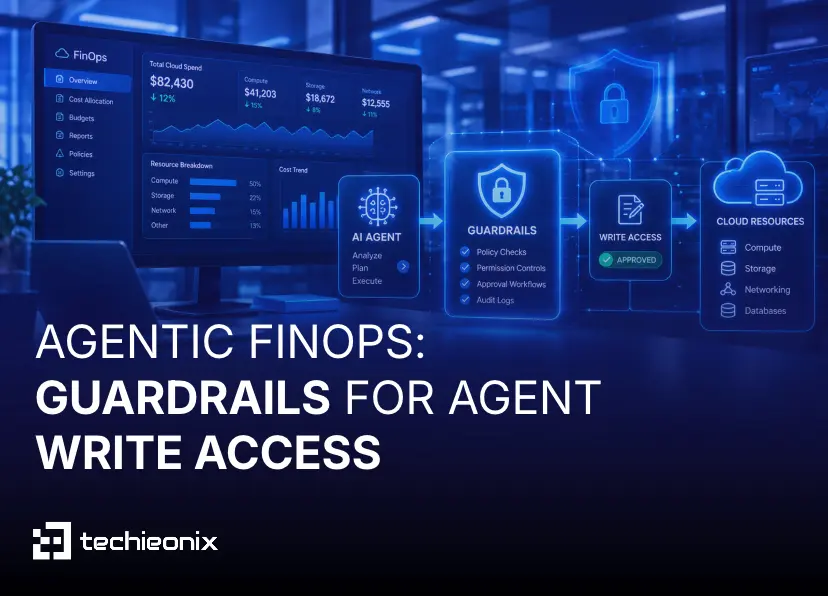
Nobody has a ready answer, because approval authority for agents is rarely written down anywhere. Giving a FinOps agent read access to your billing data is a low-risk afternoon. FinOps agent write access is a different decision, and agentic FinOps guardrails are what stand between the two. Those guardrails have almost nothing to do with which vendor you pick. They depend on whether your platform can absorb an automated change safely today, before any agent is involved.
This post is the checklist we run through, and the order to fix things in.
Where agentic FinOps guardrails actually come from
The FinOps Foundation published its own read on this recently, arguing that agentic adoption is running behind the conversation. Its framing is an autonomy spectrum: an agent can reason about what should happen, but it does not define its own authority, and only the top of the spectrum has any power to initiate change. The Foundation's advice is to route early changes through the approval path your organization already trusts, and to earn wider action one use case at a time.
Vendors have arrived at the same conclusion in their product design. The AWS FinOps Agent guardrail documentation shows the split clearly: read-only actions such as querying cost data and retrieving recommendations run autonomously, while write actions like creating a Jira issue require confirmation when triggered from a chat conversation. Even the write actions on offer are ticket and Slack operations, not infrastructure changes.
So the gate is well understood by everyone selling this. The part nobody sells you is the readiness work on your side of the line.
Start with the level that needs no write access at all
Before the checklist, get value from a read-only agent. Give a model read access to billing data, tagging metadata, and resource inventory, and ask it to investigate spikes.
The Foundation documented teams already doing this for autonomous waste discovery: the agent investigates the resource, finds the associated tags and owner, then creates and assigns a ticket. One team reported cutting initial investigation time per ticket from around 15 minutes to effectively nothing.
Most engineering teams can build this in a sprint. The worst outcome is a wrong summary a human reads and discards. Run it for a quarter, because the failures it produces are your checklist.
Track two numbers while it runs. How often the agent identified the correct root cause, and how often it found a real owner. The first tells you whether your billing and deployment data are joined well enough for an agent to reason over. The second tells you whether your tagging can support any automated action at all. A team scoring 90 percent on root cause and 40 percent on ownership needs a tagging project before it needs an agent project.
The readiness checklist
Six things have to be true before write access is a reasonable risk. Each one has a test you can run this week.
1. Infrastructure as code covers the resources the agent will touch. Partial coverage is the trap. If 60 percent of your environment is in Terraform and nobody can say which 60 percent, an agent acting on the untracked part creates drift that nothing reconciles. Test it by picking three resource types the agent would modify and confirming each one is defined in code.
2. Tagging and ownership data is complete for those resources. An agent inherits the quality of the metadata you give it. No amount of reasoning recovers an owner field that was never populated. Test it by running the read-only agent for a month and counting how many ownership lookups failed. Each failure is a specific backlog item.
3. Someone has tested the rollback path. Documented is not tested. For every action you plan to delegate, confirm a person has actually reversed it in a non-production account and timed how long it took. If the rollback takes 40 minutes, then 40 minutes is your blast radius.
4. A written action policy exists. Your cloud accounts have IAM roles. They do not have a document saying an agent may stop untagged dev instances under $200 a month but must open a pull request for anything in production. That policy has to be written by a person before an agent can operate inside it. If it is still a draft, you are not ready, and this is usually the item that stalls longest because nobody is sure they have the authority to sign it.
5. Every agent action lands in an audit trail. Each change the agent makes should link back to the run that proposed it, the data it reasoned over, and the person who approved it. Without that chain, your first incident review has nowhere to land, and the automation gets switched off permanently after one bad night.
6. The agent's own cost has a budget. Every investigation loop consumes tokens, and an agent reasoning through a hundred anomalies a day generates real inference cost. The Foundation has started treating this as a unit metric worth budgeting. Watch for the case where the cost optimization agent costs more than the waste it finds. Getting this right needs per feature cost allocation in place before the agent ships.
Items 1, 3 and 5 are DevOps automation work rather than FinOps work. Agent readiness and platform maturity are the same thing measured twice.
Grant write access in one narrow slice
Once the checklist passes, the first grant should be smaller than feels useful.
Start with propose-only. The agent generates a Terraform diff, a resource limit change, or a lifecycle policy, and it opens a pull request that goes through the same review as any other infrastructure change. No new approval path, no new trust required.
Then move one action category to bounded execution. Bounded means three things at once: the action list is short and explicit, every action is reversible, and both spend and blast radius are capped.
A realistic first policy reads like this. The agent may stop untagged non-production instances older than 14 days, up to 20 per day, in three named accounts, and it opens a ticket for every action it takes. Note what is absent. No production resources. No deletions, only stops. No cross-account authority.
Pick that first action category by reversibility, not by savings. Stopping an idle dev instance is undone with a start command. Deleting a snapshot, resizing a database, or modifying an autoscaling policy is not. The highest-value action is usually the worst first choice, because a mistake there costs you the automation program along with the outage.
Actions that stay manual
Some categories should never move to autonomous execution, regardless of how well the agent performs. Write these down alongside the action list:
Deleting production data or storage without retention and recovery proof
Resizing production databases without a tested failover path
Changing autoscaling, load balancing, or capacity settings tied to customer-facing SLOs
Purchasing long-term commitments without finance approval
Modifying IAM, networking, security groups, or firewall rules as a cost measure
Acting on any resource with missing ownership or an undefined rollback path
Set a review cadence before you switch it on. Once a month, pull every action the agent took and check three things: was the action correct, did the owner agree with it, and did anyone have to undo it. That log is what justifies widening the action list next quarter, and it is the only defensible answer when your board asks how the automation is governed.
One thing the checklist does not depend on is where the agent came from. Cloud-provider native agents, FinOps platform agents, and agents you build in-house all sit behind the same six items. The provider may supply the reasoning, but you still own the data quality, the delegated authority, the change controls, and the consequences.
Where teams get stuck
The patterns we see when an evaluation stalls:
Infrastructure as code coverage is partial and undocumented, so nobody can define a safe action list.
Tagging is inconsistent across accounts, so ownership lookups fail and every ticket lands in a shared queue.
No rollback has been tested for the specific resource types in scope.
The action policy has no owner, so it sits in a doc for two quarters.
None of these were caused by agents. They were already there, and the same finance and engineering alignment that makes FinOps function across teams is what clears them.
Worth being honest about which half is hard. When we cut a GCC e-commerce client's AWS bill by over 25 percent in 90 days, roughly $6,000 a month, finding the waste took a fraction of the time. The rest went into validating each change with an owner, sequencing it safely, and confirming the saving at bill level. You can see how that engagement was run. An agent would have accelerated the discovery. It would not have replaced the sequencing.
Ready to make your FinOps automation safer and more effective?
At Techieonix, we help SaaS and e-commerce companies improve cloud cost management, strengthen DevOps automation, and build practical agentic FinOps guardrails across AWS, Azure, and GCP. From cost visibility and infrastructure readiness to controlled automation, we help you reduce cloud waste without adding unnecessary operational risk.
Get in touch with Techieonix today to assess your cloud environment and build a safer path to FinOps automation.
Talk to an ExpertWant help applying any of this?
Most teams can run the read-only stage themselves. A scoped IAM role, a billing export, and a well-defined prompt will produce useful investigations without anyone signing off on write access.
The checklist is where outside help earns its cost, because the work is IaC coverage, rollback testing, and policy design rather than prompt engineering.
We run FinOps engagements for SaaS and e-commerce companies on AWS, Azure and GCP. Most start with a free 30 minute review where we walk the checklist against your environment and tell you which items are actually blocking you.
No sales pitch. No commitment. If your platform is not ready for write access yet, we will say so.
Or see our FinOps service packages and DevOps services.
Automate the savings. Keep the control. Build FinOps with guardrails.